Saturday, November 20, 2010

Remnants of the Iron Curtain

A remnant of the Iron Curtain still stands at Cizov, in the Czech Republic. It's about two kilometers from the actual border with Austria, creating a broad "No Man's Land." If you succeeded in getting past the fence and the guards, you might assume you were in Austria, but you'd be wrong. The former inhabitants of this area were forcibly removed and their farms and villages demolished when the Iron Curtain dropped in 1951. This area is now the entrance to Podyji National Park.


Concrete pyramidal and rectangular bollards discourage driving and parking but provide interesting geometry in the beautiful early morning fog.


If you were trying to escape, you wouldn't just have guards, dogs and barbed wire to deal with, either. Until the mid 1960s, the fence was electrified with up to 10,000 volts.


A watchtower still stands.


According to a sign at the site, between 1948 and 1989, 390 people were killed on the Czechoslovakian border while trying to escape. In addition, "654 border guards also died here, although only 10 died in conflicts with border violators. The others died from suicide, electrocution, drowning or accidents with guns."

It does make you wonder, doesn't it, how stable—or good—any country, political philosophy, religion, organization, marriage or anything could be if you risk being killed for leaving.

Thursday, November 18, 2010

Berlin's Wall: A Hurdle Successfully Leaped

A report on Berlin would be incomplete if it didn’t include an acknowledgment of the human cruelty and suffering perpetrated both in and to Berlin during the 20th Century. There were several informative exhibitions in town when we visited: “Hitler and the Germans” exhibit at the German History Museum, “Forced Labor: The Germans, the Forced Laborers and the War” at the Jewish Museum Berlin and The Museum at Checkpoint Charlie. While there are important lessons to be learned from Berlin’s history, especially lessons regarding the attitudes that led up to various events, I’m going to focus this post on the Berlin Wall—because I like its happy ending.


I have childhood memories of the wall being built in 1961, the horrifying news reports over the decades of hundreds of people being shot trying to escape to freedom, the tensions Cold War and the fear over the possibility of nuclear war. Yet those memories are dim compared to the shared euphoria watching television November 9, 1989, the night hundreds of East Germans assembled, climbed onto the wall and started chipping pieces out of it, without the guards firing or the dogs attacking. To think that night that the Cold War could end because of the will and peaceful determination of ordinary people was the best of all possible scenarios. With tears of joy, I pulled out and played two old 45 RPM records over and over that night: Born Free (Roger Williams) and People Got to Be Free (The Rascals). I remember being filled with good will—and love—toward the brave people who gathered by the wall and climbed on it and to the guards who did not shoot.


Some sections of the Berlin Wall still stand. In this area, artists have added their messages:


Throughout Berlin, the location of the old wall can be found by a double row of cobblestones in the pavement.


The Checkpoint Charlie area today:


Ironically, the wall has to be protected with another wall to keep souvenir hunters (or "wall peckers") away.


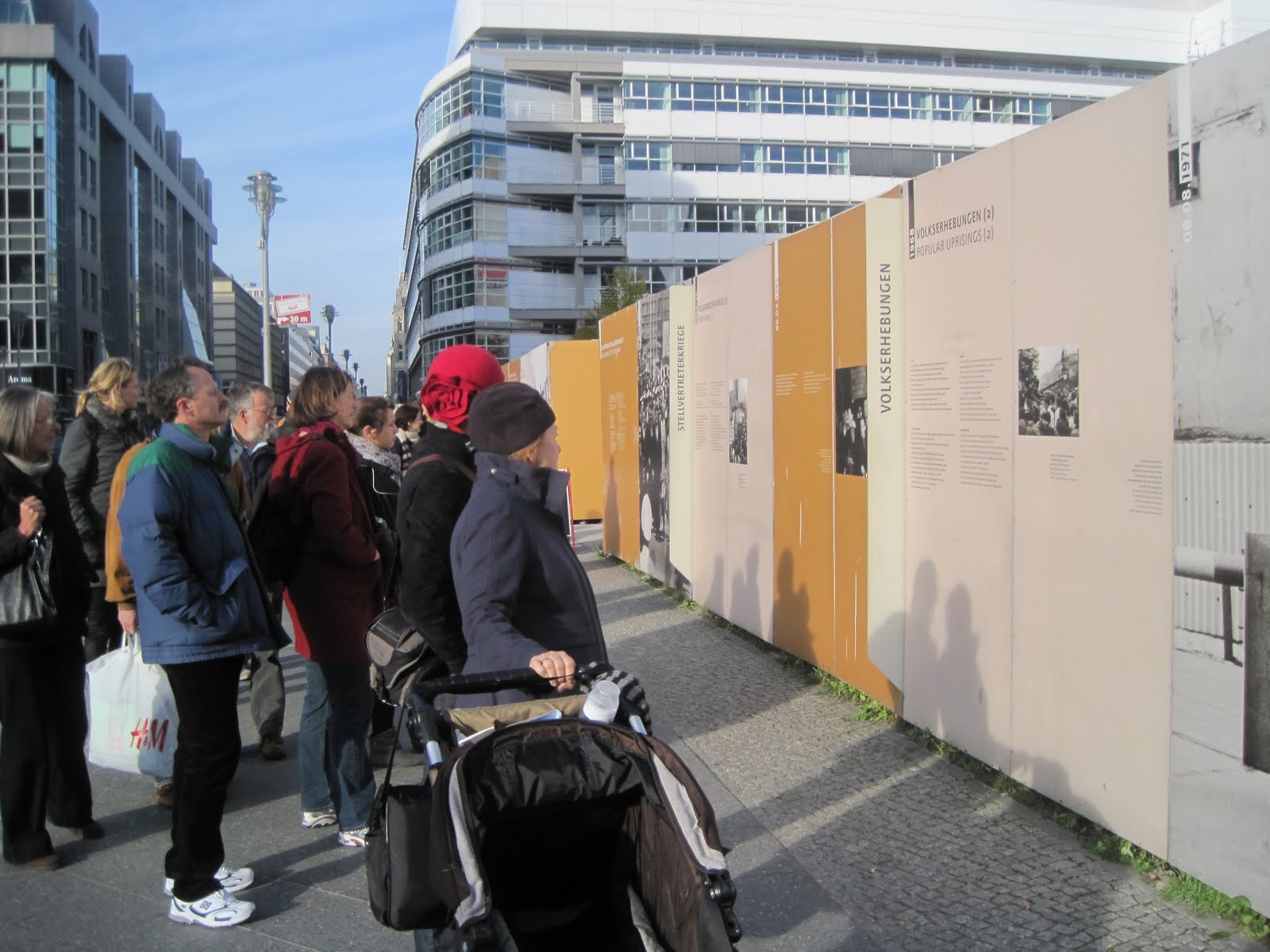
Near Checkpoint Charlie, an open display of the wall's history, attracts the attention of many visitors:


As I was standing here, I saw these two hands pop over the top of the wall. Reminiscent of the attempts of thousands of people to get over the Berlin Wall, I quickly snapped this photo. Within seconds, the hands were gone. This is one of my favorite photos:


I assume the hands belonged to one of the billboard airbrush painters working behind the wall display:


Saturday, November 13, 2010

Golden Light

We walked past this blinding bright light on a Berlin sidewalk...


reflected from this golden tower.


Thursday, November 11, 2010

Design of Berlin's Train Stations and Train Windows

I found Berlin's train stations to be somewhat fascinating. I do love the design of the Hackescher Markt Station. It opened in 1882 or 1907, according to different sources, but, regardless, I can't help but wonder about the decisions made before the design was approved. What were the arguments between saving money and creating such an ornate and labor-intensive design? What was the prevailing philosophy about architecture at the time, especially regarding buildings serving the public? What were the CEO salaries relative to the cost? Was this station a triumph of beauty over short-term economics? Are there lessons in this architecture that can help us solve the economic problems, the labor problems of today?


Berlin's new Hauptbahnhof is a modern, multi-level architectural beauty. Considering the heavy bombing Berlin endured during WW II, I had to wonder about the large advertisement in the background.


Many of Berlin's U-Bahn (subway) trains sported Brandenburg Gate decals that, from a distance, looked a bit like white lace curtains.


Wednesday, November 10, 2010

Berlin's Fancy KaDeWe

Our tour guide told us that, when the Berlin Wall fell, East Berliners crossed into the West to see Grandmother (or any other long lost relative) and then go shopping at Kaufhaus des Westens, or KaDeWe, Berlin's large department store, giving the store the biggest economic boom since its 1907 founding. It was pretty fancy:


If you click on the photo you'll see daisy-like patterns on the ground-floor tables. These are the fan blades of wooden Christmas pyramids, seen often in German shops. Heat from candles cause the blades to rotate.


The store boasts a gourmet food shop and a "Winter garden"restaurant overlooking the city:


The buffet features an assortment of tempting fruit-topped desserts:


Across the street is their colorful shop for creative crafters:


Monday, November 8, 2010

Berlin's Ampelmann Gets Moving

Berlin's walk/don't walk lights not only help you cross the street safely, they are an inspiration for both political pride and a cult industry. East Berlin's traffic psychologist, Karl Peglau, designed these instructive lights, known as Ampelmann, in 1961. When the Berlin Wall came down in 1989, West German pedestrian lights started replacing East Berlin's hatted men. Public opposition to the new lights and strong arguments for the clarity of the old Ampelmann resulted in his return throughout Berlin. The plan is to replace all old pedestrian lights with Ampelmann as they wear out. Former East Berliners take pride that something from their side of the wall prevails. After looking at pedestrian symbols around the world on the Ampelmann website, it does seem that Karl Peglau's design is the clearest; however, remembering the letters of Abigail Adams to her husband, it also appears that pedestrian designers throughout much of the world have forgotten the ladies.

The beloved hatted figure takes a walk in green:


His red color and outstretched arms clearly signal pedestrians to stop:


At night, he becomes a white light on a red background:


This is one of Berlin's stores where Ampelmann offerings abound:


Saturday, November 6, 2010

Golen's Gorgeous Jugenstile Tiles

Berlin's Hackesche Höfe is a series of nine interconnected courtyards and their surrounding buildings. The unusual tile-covered facades in the first courtyard add color, pattern and a festive ambiance.


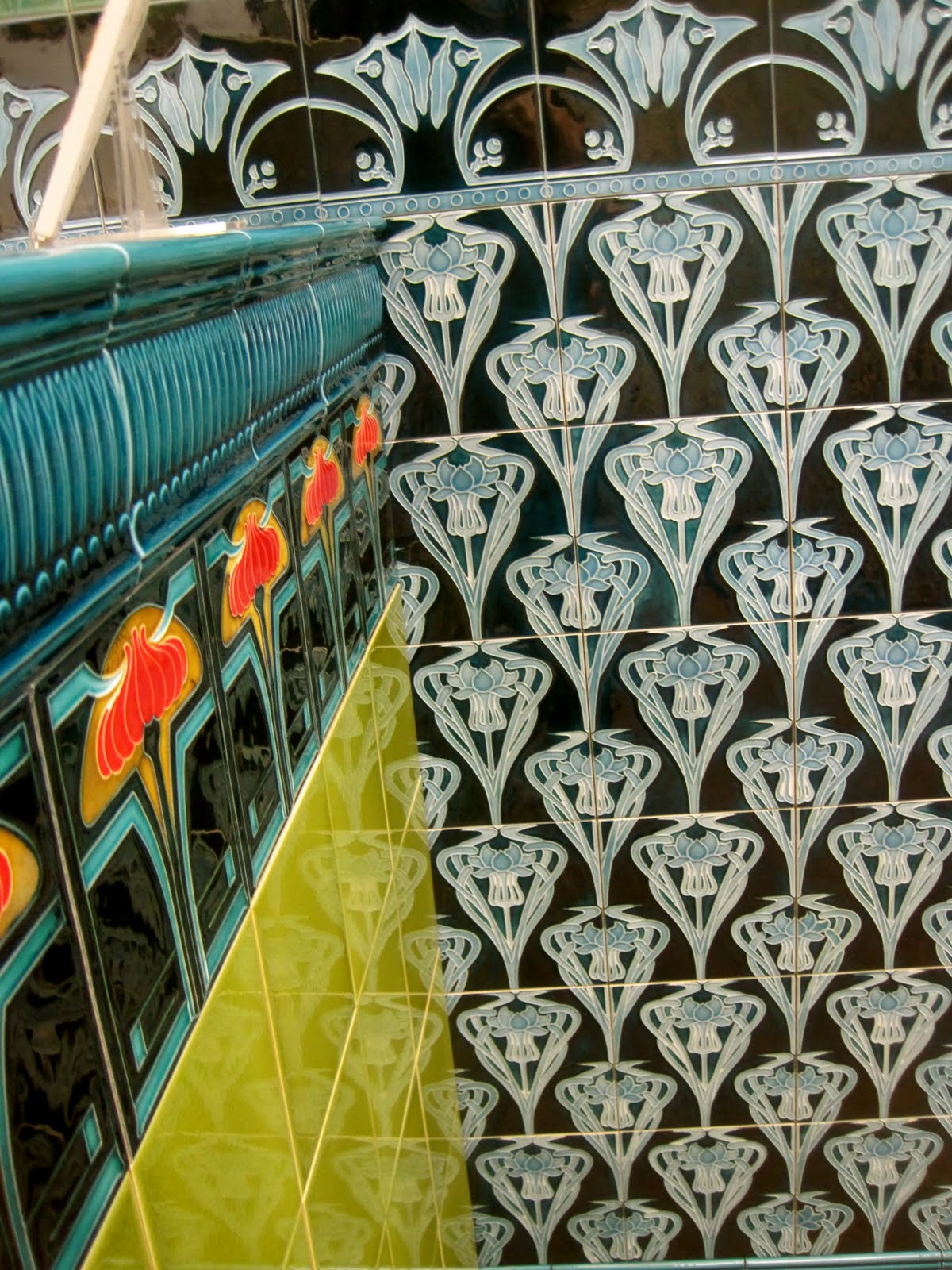
One of the shops in one of the courtyards, Golem, sells gorgeous Jugenstile tiles and provided tiles for the restoration of these facades.

I like the drama of these Golem tiles, both for their peacock reference and watercolor effect. They seem to have a bit of an Egyptian feel to me and would love to see these in a bathroom...maybe my bathroom.

Or, ahhh, perhaps these:


The shop offers quite a variety of lovely designs and colors.

Beautiful!


They also have some delightful floor patterns. I like this sampler and would be thrilled to have it in my laundry room. Durable, long-lasting ceramic tiles seem to make a lot of sense when we are trying to reduce our use of synthetic materials and toxic chemicals. I appreciate good design and I like change; admittedly, I sometimes move furniture around or buy things just for a change. However, I also like the attitude in much of Europe to build substantial buildings and to not destroy them when they go out of 'fashion' or when some company wants to build a chain store that looks like every other one of their stores across the country. There is something satisfying—as well as green—about building quality and enjoying it for a long, long time.