Friday, February 4, 2011

The Not-So-Still Life of the Amaryllis

Amaryllis plants are such a joy to watch as they grow, bloom and come into full flower. I think they are especially great for kids since they change so quickly but I never tire of them, either. I recently started experimenting with different lighting and photographed a bouquet of amaryllis in the blossom stage,


in full bloom,


and in its senior phase. I find all of these stages fascinating and beautiful...


even its decomposing roots:


Thursday, February 3, 2011

Hyacinths and Life-Enriching Links

I had these lovely hyacinths on my desk and they remind me of the enormous richness of this planet. With that in mind, I want to point you to the right column of this blog where you can find links to some pretty amazing people and ideas that enrich my life daily.

The first section contains links to various news and travel sites about Vienna and Austria as well as a great blog, Merisi's Vienna for Beginners, which could just as easily have been placed under the next topic, "Photographers I Like." Be sure to peruse those links whenever you have time. There are some real treasures there. A special thank-you to the multi-talented Markus Spring of spring2life take2 for teaching me how to create that blog roll and for occasionally posting photos of my beloved Thumsee. Also be sure to check out the gorgeous works of Beatrice Lechtanski and Diane Varner.

Under "Good Ideas for Living," you'll find just that. The list includes a way to make microloans to small business owners in developing countries, the TED videos—always fascinating and enriching; the important and eye-opening series, The Story of Stuff, which everyone should see, as well as The Girl Effect.

Under "Design Sites I Enjoy," I've included links to African Sketchbook showing their gorgeous hand-painted draperies, the popular Cote de Texas, Walking Chair Studio and Gallery (see my recent post on them), and, my newest addition, the absolutely amazing, you've-gotta-see-it-now, paper art of Karen Bit Vejle.

So in the spirit of life-enriching people and experiences, I offer these flower photos to you and my linkees. Thank you and enjoy!


Wednesday, February 2, 2011

Peru's Mysterious Nazca Lines

More than a thousand years ago, someone moved small stones around on Peru's Nazca Desert floor and created enormous designs recognizable only from the air. The shapes include a monkey, a spider, a hummingbird, a condor, a lizard, an astronaut, a dog and human hands as well as many perfectly straight lines. Why these lines were created and what purpose or meaning they had is still a mystery. But who doesn't love a good mystery? We took a flight over the lines to see them for ourselves.

It's said that this desert gets very little rain or wind and that is why the designs have been preserved for so long. I found the natural desert topography to be as interesting as the constructed lines. The patterns visible on the ground look like dried rivulets, despite the fact that this desert gets almost no rain; I think they are beautiful though:


Bird:

Here you can see a tree on the left, a bird on the right, a modern road cutting through the area and an observation platform (although from what I've heard, you can't see much from the platform).

A hummingbird:


A spider:


There's a lot going on in this photo but I'm not finding a figure. Can you?


Near the center of this photo is a parrot. Look for its beak. I don't know what the rectangles connected to it represent.


Again, the hummingbird:


I like the beautiful landscape here; it reminds me of frost on a window. The hummingbird is on the left:


They must get some rain here, or at least occasional runoff. There are a few signs of vegetation:


This one is a little harder to see. In the 7:00 position is a shark or an orca:


Tuesday, February 1, 2011

Alone in Machu Picchu

Inspired by the Inca Gold exhibit now at Vienna's Novomatic Forum, I've dug up photos of our 2005 trip to amazing Peru. I remember wishing as a child, staring at a photo similar to this, the iconic image of what is often called "The Lost City of the Incas," Machu Picchu, that I could someday see it.

Remember to click on the photos if you'd like to see them larger.


We arrived on a foggy afternoon and my initial disappointment at the weather soon turned to delight as the city in the clouds emerged and disappeared at the whims of Nature. Near the road entrance (as opposed to the Inca Trail entrance), a guard house perched on the edge of the mountain shows us what the structures would have looked like with their thatched roofs.


One display at the Vienna Inca Gold exhibit explained that the Incas believed everything should either be in a state of order or disorder and a roofless house was in a dangerous state of change, neither clearly ordered nor disordered, thereby providing an opportunity for "canker ghosts" to move in. I don't know how ghosts might be categorized but this does not sound good. Most of the Machu Picchu structures are roofless but perhaps by now that state has allowed any unhappy spirits to dissipate.


A rich model for urban agriculture, the entire city is arranged on stone terraces, very practical for successfully growing food on steep slopes (and also very practical for visitors who want some intense stepping exercise).


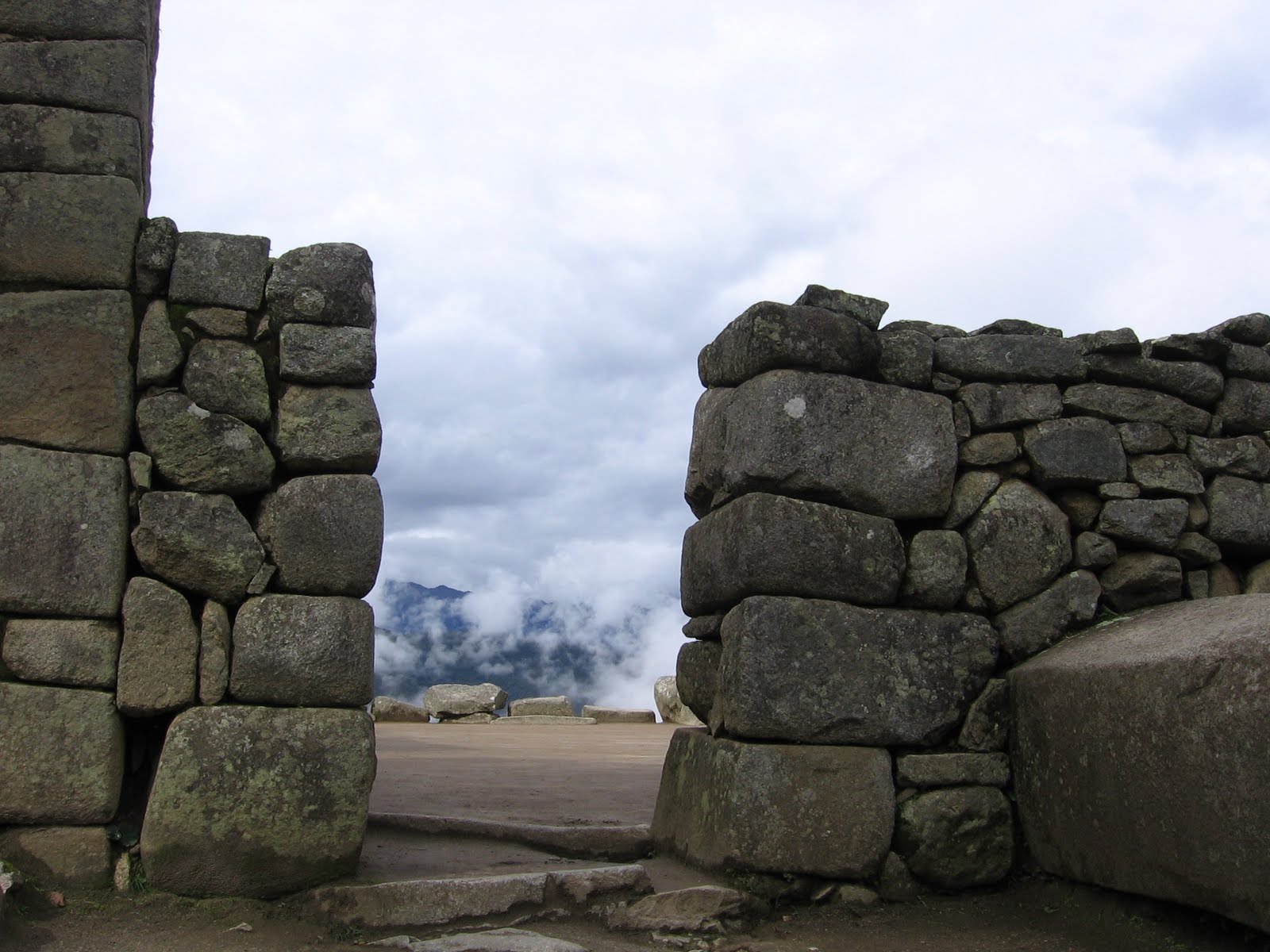
The Incas were amazingly adept at moving and carving stones to build sturdy, elegant walls:


This granite rock was carved to mimic the mountains in the background:


This treasured rock, the Intihuatana, meaning "hitching post for the sun," is believed to have served as as astronomical observatory and is thought to have special energetic properties. While many of these kinds of rocks existed throughout the Inca civilization, Machu Picchu has the only one not destroyed by the invading Spaniards centuries ago. This one was, however, damaged by a crane used in the making of a beer commercial in 2000.


Another overview of Machu Picchu ("Old Peak") with the sacred Huayna Picchu ("Young Peak") in the background. My David climbed the steep trail and crawled through a cave up to the top of Huayna Picchu. Having lost his bamboo walking stick to the canyon depths when it separated from its woven handle, he returned exhausted, covered in mud and sweat, woven handle still in hand, but beaming with accomplishment.


The Urubamba River slinks through the valley below. You might remember it flooded badly a year ago and the rising water combined with mudslides, damaged the railway and blocked the entrance to Machu Picchu. Hundreds of persons, mostly tourists, were evacuated by helicopter.


It's hard to imagine the three-dimensional planning and technical skills needed to craft such an incredible wall. A labyrinth of holes and protrusions on the back sides of many of these walls tie the stones together securely.


This is "Sacred Rock," that also was carved to mimic the mountains in the background. It stands at the trail to Huayna Picchu.


An assortment of llamas, alpacas, vicunas and guanacos posed picturesquely throughout the site. Have you noticed the absence of people? We were there on Christmas Eve and Day and, for awhile, we were thrilled to pretty much have the extraordinary Machu Picchu to ourselves. Unforgettable!


Walking sticks propped up at the entrance and freely available were priceless aids for climbing up and down the steep terrace steps.